South River Miso

Winter is a particularly good time to slow down and consider what truly nourishes us—body, soul, and spirit alike. When the days are short and cold, even the hardiest among us benefit from a reminder to consider care, community, and intention. That sense of grounded warmth is exactly what we found during a visit to South River Miso, whose Western Massachusetts property is as beautiful as the miso made there. I’ll also mention that before even stepping foot onto the South River Miso property, we knew to expect something special because everyone who heard we were going there told us that they’ve been enjoying this miso for many years.
South River Miso has an unofficial history dating back to when Christian and Gaella Elwell met in 1976, while they were both studying macrobiotics under the tutelage of Michio and Aveline Kushi. Every morning there began with a bowl of miso soup, sparking the first thoughts of local miso production. They both went on to study with Naboru Muramoto, an expert in oriental medicine and fermented foods in Glen Ellen, California, which deepened their love for and knowledge of miso.
Upon returning to Massachusetts,the Elwells were contacted by a friend who had started the Ohio Miso Company, asking if they’d be interested in taking over that venture. Christian and Gaella had just purchased some land in Conway, MA, as they were preparing to become homesteaders and intended on growing their own food. It was exceptional timing and the perfect alignment of resources and genuine interest. They couldn’t say no!
The Elwells built their production facility in 1981 with local and reclaimed timber they’d found through a local newspaper ad, a testament to the ingenuity, craftsmanship, and sense of community at the core of the company. Since the Elwells built the facility from scratch, they were able to create things as needed, such as a cooking cauldron embedded directly into a masonry wood-fired stove. Many things were made bespoke to incorporate the equipment brought over from the Ohio Miso Company facility. The koji room, described in further detail below, was entirely designed around the koji fermentation trays inherited from the Ohio Miso Company.
Most of us are familiar with miso soup, but what is miso, exactly? Miso is a high-protein seasoning that is considered sacred and medicinal in Japanese culture and has been a staple there for well over 1,000 years. Miso can be used in soups, stir fries, sauces, grain dishes, meat dishes, and in desserts. It’s really quite versatile. Christian regularly makes miso fermented oatmeal porridge, mixing a little light miso into cooked rolled oats for breakfast.
All of the miso is made from three base ingredients: salt, a grain, and a bean, with additional ingredients added to some, such as garlic and pepper paste in the Garlic Red Pepper Miso. What changes are the type of grain, the type of bean, the proportions of each and, crucially, the length of fermentation. Sweet White Miso ferments for just three weeks, while other varieties age for a minimum of three months, with some resting quietly resting in wooden vats for up to three years. Each long-aged variety is fermented in three vats at a time, ensuring access to at least one for packaging at all times.
Here is a simplified run-down of the lengthy and somewhat complex miso-making process:
1. Grain is soaked overnight and then steamed in the wood-fired cauldron for about 45 minutes.
2. Steamed grain is spread out and cooled down to a temperature of
112 degrees.
3. Grain is inoculated with the spores of Aspergillus oryzae, a beneficial mold that will transform the grain into sweet, fragrant koji.
4. The koji is transferred to a large wooden box called the ‘crib’ in the koji room. The temperature of the koji rises overnight from about 82 to about 100 degrees.
5. The koji is portioned into shallow wooden trays to allow the aerobic fermentation of the koji to continue without overheating.
6. The koji is stirred by hand, to further disperse the heat generated by the intense metabolic growth of the Aspergillus mold.
7. On Day Three the koji is ready to be harvested.
8. The harvested koji is mixed with a measured amount of sea salt. The amount of salt used depends on the variety of miso and its intended length of fermentation.
9. Beans are first sorted, then washed and soaked.
10. The beans are boiled by gentle wood fire for about six hours of active cooking. They remain in the cauldron overnight.
11. The next morning the cooked beans are transferred into a large, stainless steel treading box and allowed to cool down to body temperature.
12. ‘Seed’ miso from a previously produced batch of the same variety of miso is added. (This is equivalent to the sourdough starter in bread making. Each new batch of miso is linked in this way with the ancestral lineage of miso.)
13. The beans are mashed underfoot.
14. The salted koji is now mixed with the mashed beans, along with any specialty ingredients depending on variety.
15. The raw miso is transferred to the vat building and placed into the designated fermentation vat.
16. The miso is packed down, smoothed off, and sealed with a muslin cloth and wooden pressing lid, with heavy weights placed upon it. Liquid rises up to the surface and seals the miso from exposure to the air.
17. The raw miso remains in the vat for up to three years.
18. After the designated fermentation time the vat is opened and the miso is harvested by hand.
19. The finished miso is hand packed in glass jars.
20. Time for you to enjoy!
One of the most important things to know about South River Miso is that their production techniques are all as traditional as possible, using methods dating back to pre-World War ll Japan–—something that no longer exists in large-scale miso production. All bean cooking is done via boiling, rather than pressure cooking, and the majority of the varieties get several hours of foot treading in the production room. All rice and barley are steamed.
We had the pleasure of seeing Alex, one of the production technicians, tread a batch of miso during our visit. It was mesmerizing! It takes about one hour to tread a 500 pound batch of miso, of which there are four batches during a normal production week. Alex calls it a natural stairmaster and says it’s an excellent way to remain present in the body and connected with the outcome of the product. You might imagine the mind wandering during such a long, physical process, but Alex says his mind is very much focused on how he feels the beans behaving under his feet. He’s not just walking around in some beans, he’s ensuring consistency throughout the batch and that makes the treading a more focused meditation, much like sculpting. If you’ve ever lost yourself in the process of making art you might understand what Alex is talking about. It becomes a productive, enjoyable flow, learned through a combination of lessons passed down through generations and one’s own experience treading.
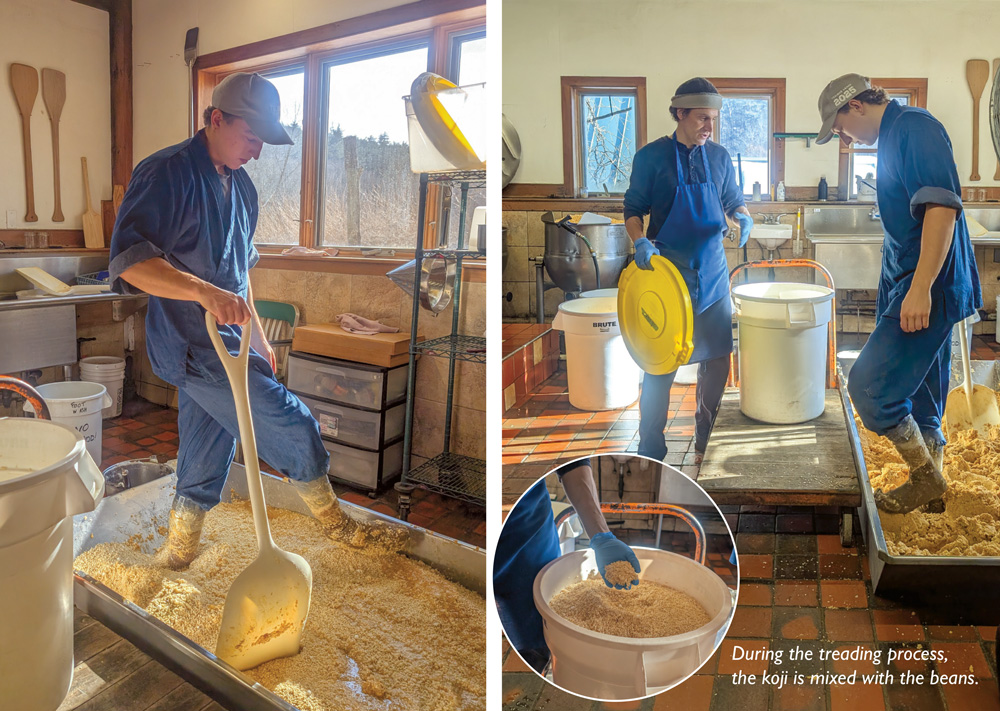
South River did not start out treading their beans, but happily switched to producing this way when the small meat grinder they were using broke down. Christian tread the miso himself out of necessity in order to keep production going, but said this was the first time he felt he was truly a miso maker steeped in the spirit of the tradition. It became important to him to incorporate foot treading moving forward as a way to increase the intentionality of production, ensure a high-quality end product, and to keep the connection between human energy and the food.
Their philosophy centers around keeping production small. The goal has never been to make miso for every household in the country, but to make miso with care—for the people who craft it, for the traditions it comes from, and for the quality of the final product. Rushing fermentation or increasing output at the expense of working conditions simply isn’t part of the equation. Foot treading is the final human interaction before fermentation begins, and for many at South River, it marks the moment when miso making becomes deeply personal—a responsibility, not just a task.
Today, South River Miso produces over 40 tons of miso annually from the same modest production room, much of it using original equipment from Ohio. What began with adventurous apprentices wading across the South River to work has grown into a close-knit team of ten employees, all contributing their energy and care to the process.
In a world that often equates success with scale, South River Miso offers a quieter, more sustainable model. One rooted in patience, tradition, and the belief that we change the world by what we choose to eat—and how we choose to make it.
So what’s next for South River Miso?
Stay small. And get a round treading tub. That’s about it and we love that!!
Available at the Co-op:
As is traditional, if the bean variety is not listed, it is assumed to be soy.
Sweet-Tasting Brown Rice – Sweet, savory, and highly versatile.
Sweet White – Famous to the Kyoto region of Japan, this miso has a relatively sweet flavor and smooth, creamy texture. Sweet White Miso has the lowest salt content of all the varieties. It also has the shortest fermentation time and is the only variety that is mechanically ground.
Azuki Bean – Azuki Bean Miso is prized for its delightful, delicate flavor; for its festive, red burgundy color; and for its unique healing properties. Azuki Bean Miso is made exclusively at South River.
Three-Year Barley – South River’s original hearty miso variety. It is ideal for hearty soups and stews and for simple medicinal healing broths.
Hearty Brown Rice – Deep, dark and delicious. The sweetness derived from the brown rice combines with the rich flavor of black soybeans, known for their rich sweetness and fullness of flavor.
Chickpea – The chickpea speaks to the warm heart of the Mediterranean soul! Now, through the ancient art of miso fermentation from Japan, three cultural streams join together to create Chickpea Miso in New England!
Garlic Red Pepper – Fresh steamed garlic and red pepper paste are combined together with our Chickpea Miso base of ingredients for this mildly spicy miso. The red pepper paste combined with the yellow chickpeas gives a gorgeous warm orange glow to this miso. Nettle greens and sea vegetables add to its immune-strengthening, healing properties. Delicious and bright! Aged for a minimum of three months.
Dandelion Leek – This special variety is great for an instant soup broth in the workplace or for a “pick-me-up” instead of coffee.
Written by Sarah Galgano